Home › Resources › Qualiopi for a simulation center: criteria and evidence
Qualiopi for a simulation center: criteria and evidence
A simulation center in France that sells courses funded by public or pooled training funds must hold Qualiopi certification. Here is what the framework actually expects from a center, and how to avoid the evidence scramble the night before the audit.
In this guide
Qualiopi: who needs it?
Since 1 January 2022, Qualiopi certification has been required in France to access public and pooled vocational training funds: skills operators (OPCO), the personal training account (CPF), the State, regions and France Travail. It is issued by a certification body for three years, with a surveillance audit between the 14th and 22nd month.
The national quality framework has 7 criteria and 32 indicators. Some only apply to certain programs, such as apprenticeships; a simulation center offering continuing education is mainly concerned with the common indicators.
For the continuing professional development (DPC) of healthcare professionals, registration with the national DPC agency is a separate process. In Switzerland, the reference label is eduQua.
The 7 criteria in plain words
- Inform the public about courses, access times and results achieved.
- Define objectives and tailor each course to its audience from the design stage.
- Adapt welcome, support, follow-up and assessment to participants.
- Provide suitable means: teaching, technical and supervisory.
- Qualify and develop the people who teach.
- Engage with the professional environment: monitoring, networks, partners.
- Collect feedback and complaints, and turn them into improvements.
Evidence expected in a simulation center
The auditor does not want documents written for the audit; they want to see traces of how you actually work. In a simulation center these often exist already, but they are scattered.
- Criteria 1 and 2: programs with objectives, prerequisites, duration, assessment and accessibility arrangements; published results indicators.
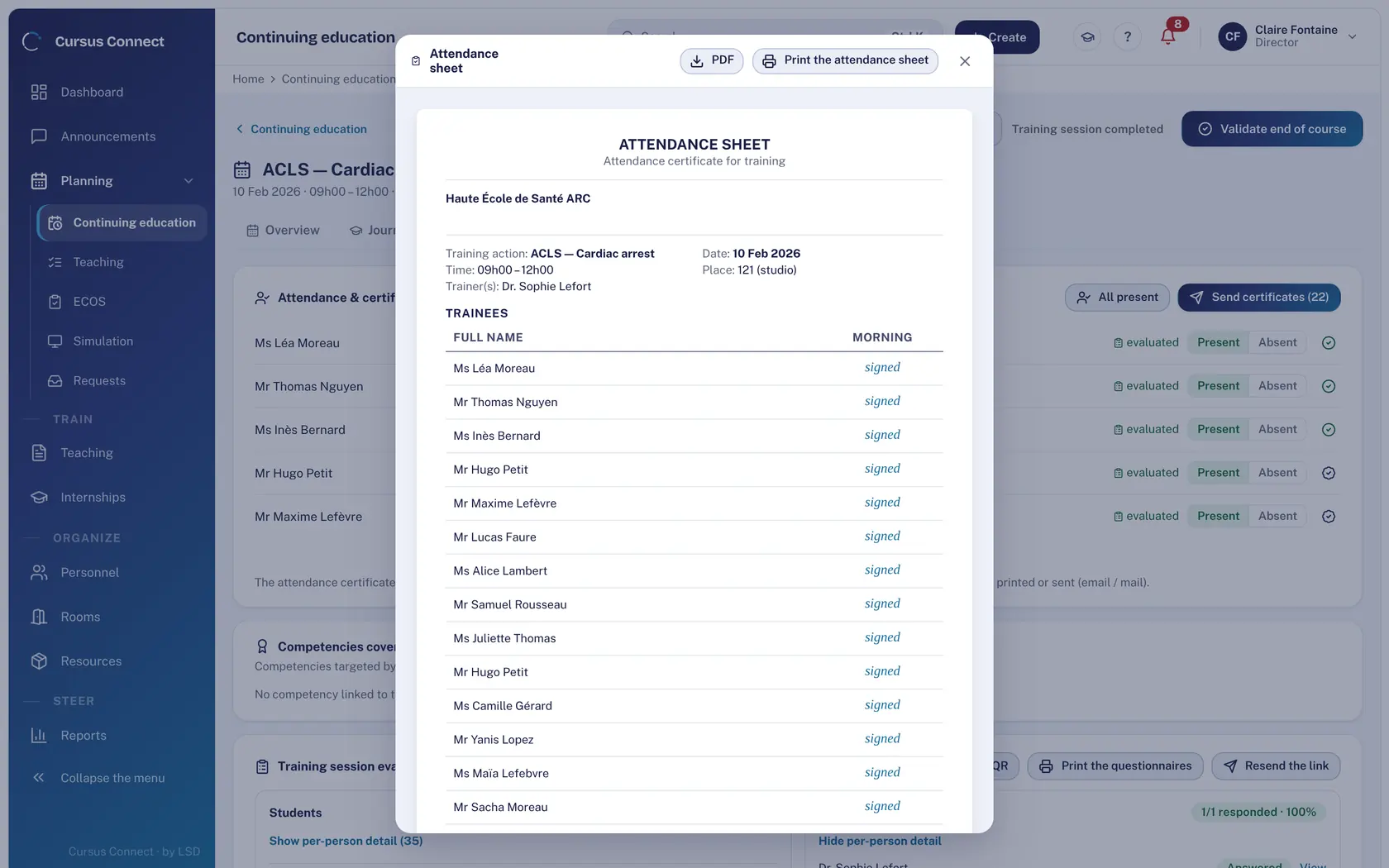
- Criterion 3: entry assessment, attendance sheets, learning assessment, certificates of completion.
- Criterion 4: rooms, simulators and their maintenance, up-to-date scenarios and materials.
- Criterion 5: CVs, qualifications and training of educators, including simulation pedagogy and debriefing.
- Criterion 6: regulatory, teaching and technology monitoring, involvement in networks and conferences of the field.
- Criterion 7: satisfaction surveys, complaint handling, improvement plan.
Produce evidence as you go
The safest approach is to let evidence come out of the activity itself, rather than building a separate file before each audit.
- a single place for courses, enrollments, attendance and assessments;
- numbered attendance sheets and certificates that cannot be altered afterwards;
- satisfaction surveys sent automatically right after the course and some weeks later;
- an indicator checklist with an owner and a due date for each;
- a quarterly review rather than a sprint in audit week.
In Cursus Connect
The Quality module keeps the 7 criteria and 32 indicators as a checklist with owner, due date and status, and assembles 12 months of evidence on attendance, signatures, satisfaction, follow-up impact and educator qualifications. The report comes out as a PDF with an Excel tracking workbook. Criterion 7 registers are kept outside Cursus Connect: the report says so.
Frequently asked questions
Are Qualiopi and DPC the same thing?
No. Qualiopi is required to access public and pooled vocational training funds in France; DPC for healthcare professionals relies on a separate registration with the national DPC agency.
What happens between two audits?
A surveillance audit takes place between the 14th and 22nd month after the initial audit, then a renewal audit before the three years are up.
Can software guarantee certification?
No. A tool gathers evidence and keeps the checklist; validating indicators remains the job of your quality lead, and the decision remains the auditor’s.
Read next
How to run an OSCE: a step-by-step guide
Competencies, stations, scoring grids, standardized patients, circuits and rounds, exam day and results: the complete method to run an OSCE without spreadsheets.
Running a simulated patient program: the guide
Recruit, train, write roles, schedule, protect and retain: the steps to build a reliable simulated patient program in your center.
See your center in Cursus Connect
An online demo built around your courses, your OSCEs and your documents. You leave knowing what Cursus Connect will change for you.