In this guide
What is an OSCE?
The Objective Structured Clinical Examination (OSCE) assesses clinical competencies in realistic situations. Each candidate rotates through a series of timed stations; at each one, an examiner scores the performance with a grid that is the same for everyone. Many stations involve a standardized patient, played by a trained person.
Long established in medical education, the OSCE is spreading across nursing and allied health programs. Its strength is fairness: same situation, same grid, same time for every candidate. That is also what makes it demanding to organize.
1. Define what you assess
It all starts with a map linking target competencies to clinical situations, often called a blueprint. It ensures the exam covers what it should, with no duplicates and no gaps.
- the domains assessed: communication, physical examination, clinical reasoning, technical skills, patient education;
- the situations chosen and how they are spread across stations;
- the expected level, aligned with the program’s framework;
- the type of assessment: formative, for practice, or summative, with stakes for the candidate.
2. Write the stations and grids
Each station brings together four documents: the candidate instructions, the scenario, the standardized patient’s role sheet and the scoring grid. Add the equipment list and the room layout.
- short, unambiguous instructions that can be read in under a minute;
- a realistic duration for the task, often 5 to 10 minutes, the same for all;
- a grid of observable items, with a global rating if needed;
- a review by a second educator, then a dry run under real conditions.
The classic trap: a grid so long the examiner cannot complete it in time. Ten well-chosen items beat thirty ticked in a hurry.
3. Prepare standardized patients and examiners
Standardization cannot be improvised. Each standardized patient receives the role sheet in advance and rehearses with an educator; each examiner reviews the grid and agrees with the others on what earns a point.
- a joint briefing before the exam, station by station;
- planned stand-ins: a standardized patient on call avoids cancelling a circuit;
- examiners who do not know the candidates, whenever possible.
4. Plan circuits and rounds
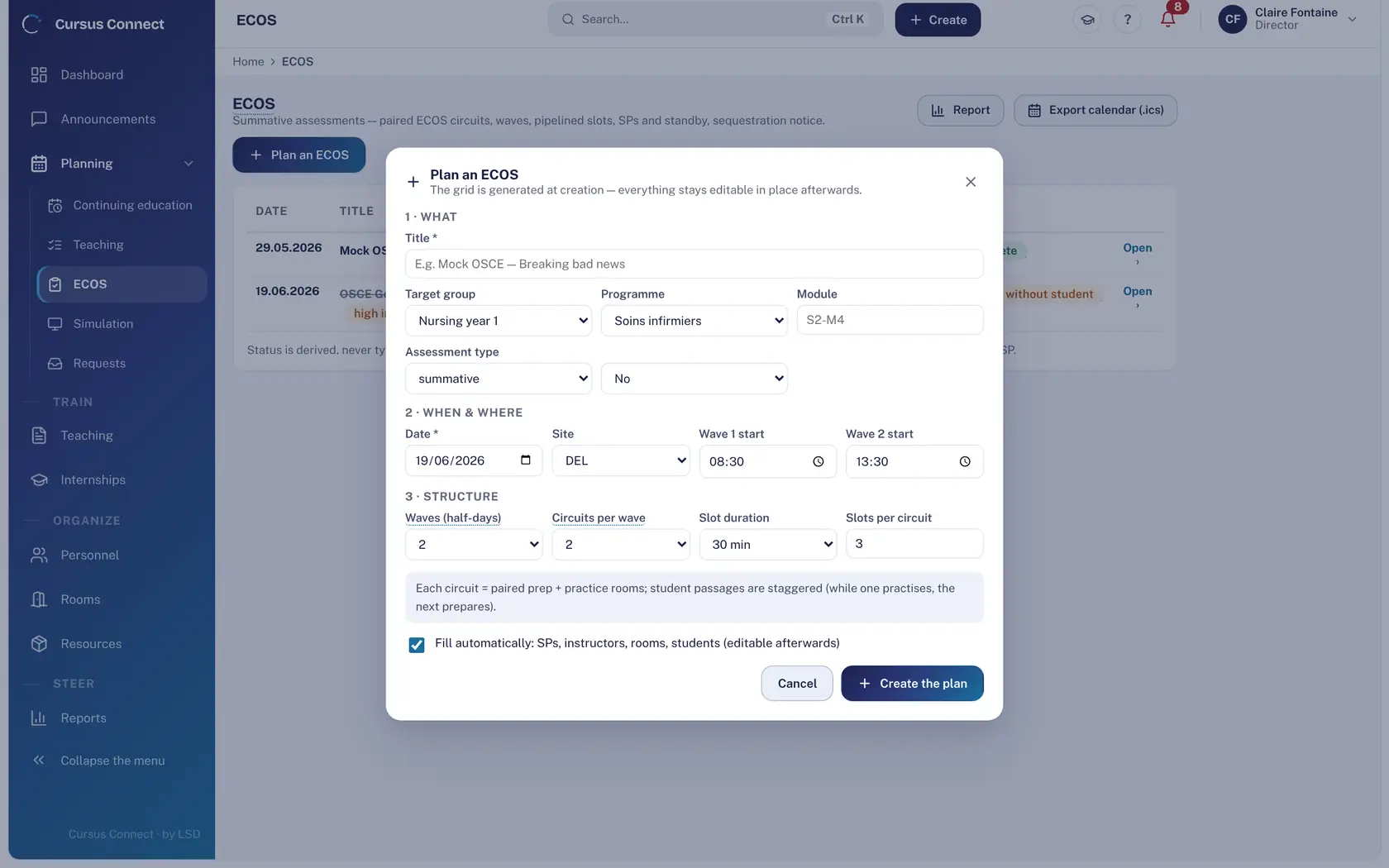
A circuit chains all the stations; candidates rotate through it together. A round runs a group of candidates through one or more parallel circuits. The math is simple, but it has to be right.
Example: a circuit of 8 stations takes 8 candidates at a time. Each rotation lasts 10 minutes (8 minutes at the station, 2 minutes to move): a round therefore takes 80 minutes. With 3 parallel circuits, one round examines 24 candidates; 120 candidates need 5 rounds, or 6 hours 40 minutes of exam time, not counting breaks and briefings.
Then multiply: each circuit needs its own rooms, examiners and standardized patients. Three circuits of eight stations mean 24 rooms or spaces, 24 examiners and often as many standardized patients.
5. Exam day
- welcome and identification of candidates, shared general instructions;
- printed grids kept under seal, handed out station by station;
- a single, audible timer for all circuits;
- one person tracking circuit progress and handling absences and delays;
- time for standardized patients to step out of role at the end of the day.
6. After the exam: results and feedback
Consolidate the grids, calculate results per station and per candidate, then look at the stations themselves: a station where everyone fails, or everyone passes, often points to a problem with the instructions or the grid. Finally, report back to candidates with feedback that helps them improve.
In Cursus Connect
The OSCE module generates the exam grid at creation (rounds, circuits, passes), calculates a planning status that says what is missing, suggests simulated patients matching the required profile, prints grids with the sealing instruction and tracks circuits in real time.
Frequently asked questions
How long does an OSCE station last?
Most often 5 to 10 minutes, plus rotation time. What matters is that the duration fits the task and is identical for every candidate.
Does every station need a standardized patient?
No. Communication and examination stations do; others rely on a manikin, a task trainer or a document to analyze.
Formative or summative OSCE: what changes?
The organization is the same; the requirements are not. A summative OSCE requires validated grids, trained examiners, strict station confidentiality and traceable results.
Read next
Running a simulated patient program: the guide
Recruit, train, write roles, schedule, protect and retain: the steps to build a reliable simulated patient program in your center.
Qualiopi for a simulation center: criteria and evidence
Who must be certified, the 7 criteria explained, the evidence an auditor asks for in a simulation center, and how to produce it as you go. For centers in France.
See your center in Cursus Connect
An online demo built around your courses, your OSCEs and your documents. You leave knowing what Cursus Connect will change for you.